
TOPDON TC001 Max Dual-Lens Thermal Camera for Smartphones, 256×192
Available to order
Included with qualifying purchases of $100 or more. Coverage begins on delivery and protects against manufacturing defects and failures under normal use.
- 30-Day ReturnsHassle Free
- 2-Year WarrantyOn qualifying $100+ purchases
30-day returns and damage protection Return most items within 30 days. If your order arrives damaged, we will replace it or refund you. Free shipping on every order.
Product details
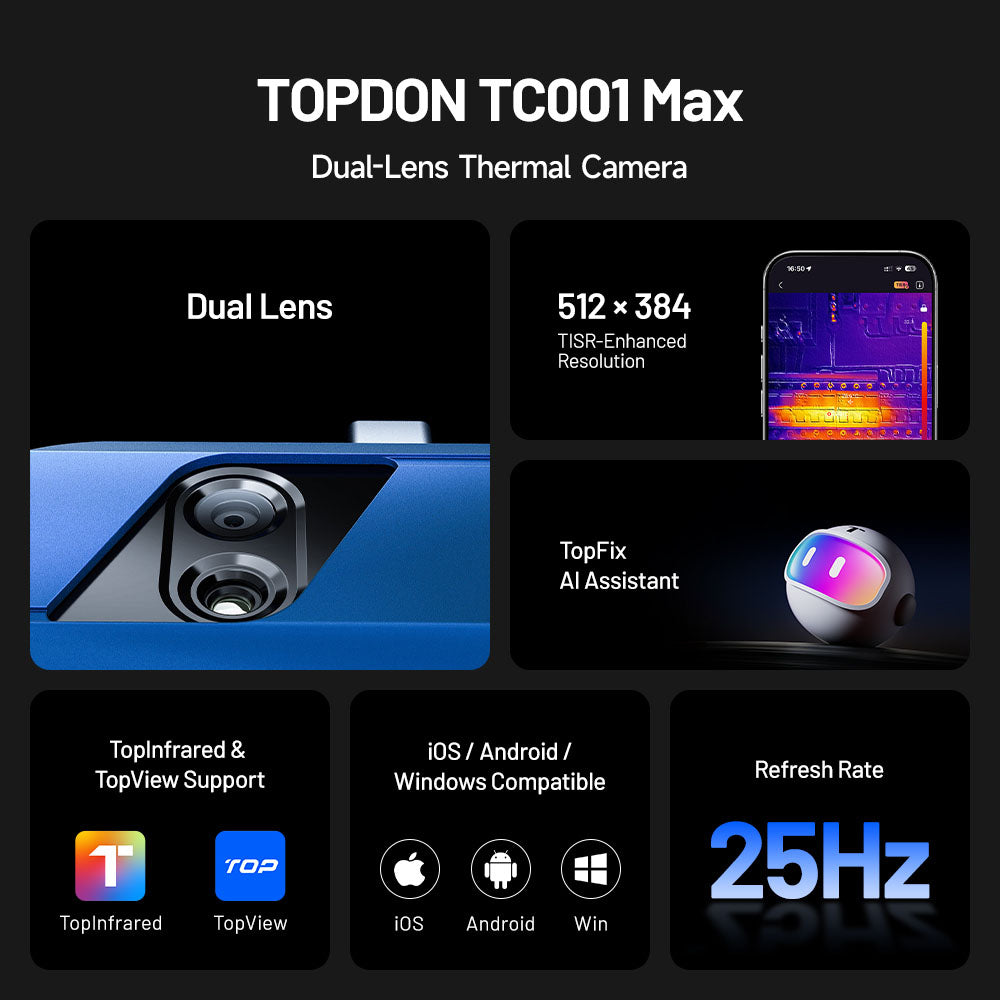
Plug the TOPDON TC001 Max into a phone, tablet or Windows PC and you have a dual-lens thermal imager that weighs just 33 g. A 256×192 infrared sensor sits beside a 1.5 MP visible-light camera, and TISR processing outputs a 512×384 thermal picture, so you can see a hot spot and match it to the real component or surface in front of you.
At a glance
- 256×192 infrared sensor, enhanced to 512×384 with TISR
- Dual lens with thermal, visible, dual-light and picture-in-picture modes
- ≤40 mK sensitivity and a 25 Hz refresh rate
- -20°C to 550°C range with ±2°C or ±2% accuracy
- USB-C connection for Android, iOS and Windows
Full specifications
- Infrared sensor: 256×192 (49,152 thermal pixels)
- Enhanced output: 512×384 (TISR)
- Visible-light camera: 1.5 MP
- Thermal sensitivity (NETD): ≤40 mK
- Refresh rate: 25 Hz
- Temperature range: -20°C to 550°C (-4°F to 1,022°F)
- Accuracy: ±2°C or ±2%
- Lens: 3.2 mm, fixed focus
- Weight: 33 g
- Connection: USB-C
- Compatibility: Android, iOS and Windows
What the specs mean in practice
Resolution. The sensor captures 49,152 temperature points per image. TISR upscales that to 512×384 to sharpen edges, but the real measurement grid stays 256×192, so treat the extra sharpness as a viewing aid. The bigger practical win is the visible camera: in dual-light mode you can see exactly which wire, fuse or pipe fitting a hot spot belongs to.
Sensitivity. At ≤40 mK the camera can separate surfaces that differ by 0.04°C or less. That helps with faint patterns such as a slightly warm breaker, a cool draft or an uneven floor-heating loop.
Range. -20°C to 550°C covers building, HVAC, electrical, automotive and electronics work. Furnaces and kilns above 550°C need a high-temperature instrument.
What you can use it for
- Electrical: spot an overloaded breaker, a loose lug or a warm connection before it fails.
- HVAC and plumbing: trace hot-water lines, compare supply and return temperatures and find blocked coils.
- Buildings: find missing insulation, air leaks around windows and cold, damp patches.
- Electronics and automotive: find an overheating component on a board or an uneven heat pattern across a radiator.
Who should look elsewhere
- You want a standalone camera with its own screen and battery. See the MILESEEY TR20.
- You have an iPhone 14 or earlier. Those use Lightning, and this module connects by USB-C.
- You need temperatures above 550°C.
How it compares
- Thermal Master P3: adds manual macro focus, under 35 mK sensitivity and a 600°C range. The TC001 Max adds the visible-light lens.
- Thermal Master P2: even smaller and Android only, with a 600°C range and a 1.5°C accuracy rating.
Tips for better results
- Scan electrical equipment under normal load and compare like with like, such as the three phases on a breaker. A fault shows up as a difference, not an absolute number.
- Shiny bare metal reads cooler than it really is. Stick a small piece of black electrical tape on the surface and measure the tape instead.
- Glass blocks thermal imaging. The camera shows the temperature of the glass surface, not what is behind it.
- For building checks, a difference of roughly 10°C (18°F) or more between inside and outside gives the clearest pictures of insulation gaps and drafts.
Frequently asked questions
Does it need its own battery?
No. It draws power from the connected device.
What does TISR mean?
It is TOPDON's image-enhancement processing. It upscales the 256×192 sensor image to 512×384 and sharpens edges and contrast. The sensor resolution itself stays 256×192.
How is it different from the original TC001?
The Max adds a visible-light camera with dual-light and picture-in-picture modes, and its sensitivity is ≤40 mK versus under 50 mK on the original.
Which devices work?
Android phones, iPhones and iPads with USB-C (iPhone 15 and newer), and Windows PCs.
Can it see through walls?
No. Thermal cameras read surface temperature, so they reveal heat patterns on a wall, not what is behind it.
Common applications
Electrical troubleshooting, HVAC temperature checks, Building inspections. Choose a thermal camera based on the target size, working distance and required measurement accuracy.
Buying guidance
Compare native infrared sensor resolution, temperature measurement range and device compatibility before ordering. Image enhancement does not increase native sensor resolution. For questions about suitability, contact ThermalVisionPlus before purchase.
Thermal camera buying guides
Compare models and learn what specifications matter in our home inspection thermal camera guide, HVAC thermal camera guide, and phone versus handheld comparison.