
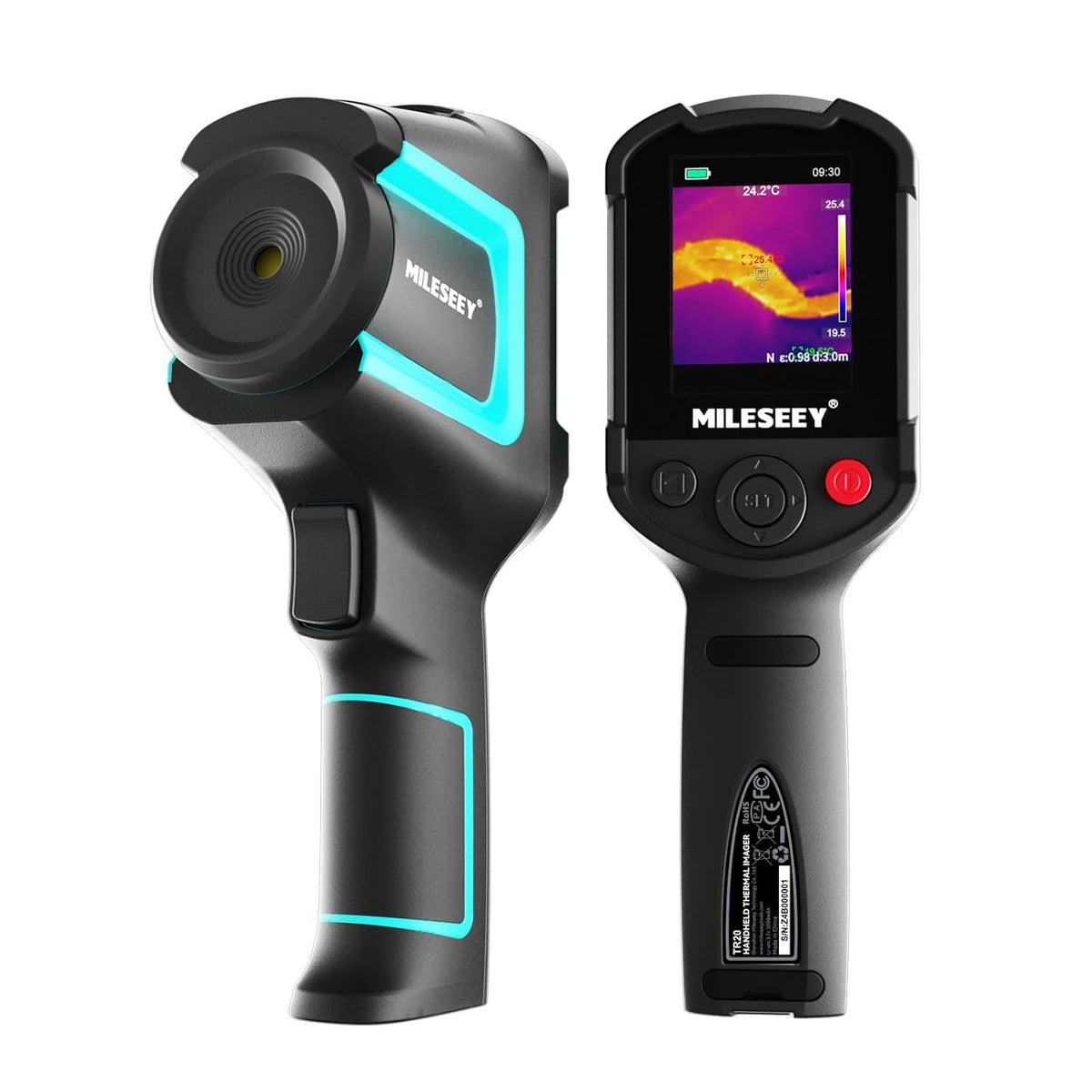
MILESEEY TR20 Handheld Thermal Imaging Camera, 320×240, 50Hz, 40mK
Available to order
Included with qualifying purchases of $100 or more. Coverage begins on delivery and protects against manufacturing defects and failures under normal use.
- 30-Day ReturnsHassle Free
- 2-Year WarrantyOn qualifying $100+ purchases
30-day returns and damage protection Return most items within 30 days. If your order arrives damaged, we will replace it or refund you. Free shipping on every order.
Product details
The MILESEEY TR20 is a handheld thermal camera with a 320×240 infrared sensor (76,800 thermal pixels), a fast 50 Hz refresh rate and sensitivity of 40 mK or better. It is built for HVAC technicians, electricians and home inspectors who need sharp detail and smooth live imaging.
At a glance
- 320×240 infrared sensor (76,800 pixels)
- 50 Hz refresh rate and ≤40 mK sensitivity
- -20°C to 550°C with ±2°C or ±2% accuracy
- Wide 50° × 37.2° field of view and a 2.8-inch screen
- Auto hot and cold spot tracking, alerts and video recording
Full specifications
- Infrared resolution: 320×240 (76,800 pixels)
- Thermal sensitivity (NETD): ≤40 mK
- Refresh rate: 50 Hz
- Temperature range: -20°C to 550°C (-4°F to 1,022°F)
- Accuracy: ±2°C or ±2%
- Field of view: 50° × 37.2°, wide angle
- Display: 2.8-inch LCD
- Features: auto hot and cold spot tracking, video recording, high and low temperature alerts
What the specs mean in practice
Resolution and spot size. 320×240 gives about 56% more thermal pixels than a 256×192 camera. With a 50° field of view each pixel covers about 2.7 mm at 1 m (27 mm at 10 m), so smaller hot spots and finer edges show up clearly.
50 Hz refresh. The picture updates twice as fast as a 25 Hz camera, so panning across equipment looks smooth instead of choppy.
Sensitivity. 40 mK or better separates surfaces that differ by 0.04°C. That is useful for subtle patterns such as faint moisture, a slightly warm connection or uneven radiant heating.
What you can use it for
- Electrical panels: scan breakers and busbars, where a wide view covers more in one frame.
- HVAC: check coils, ducts and refrigerant lines.
- Home inspection: find insulation gaps, air leaks and moisture patterns.
- Reporting: record video of a scan to show a client.
Who should look elsewhere
- You want a lower-cost entry camera for occasional use. The MILESEEY TR10 or UNI-T UTi120S cost less.
- You need to measure above 550°C.
How it compares
- UNI-T UTi260B: 256×192 with a fusion mode and an IP65 body.
- MILESEEY TR10: 192×192 at 25 Hz, with an 8-hour battery.
- VEVOR Pro: a larger 3.45-inch screen and a 2 MP visible camera.
Tips for better results
- Scan electrical equipment under normal load and compare like with like.
- Shiny bare metal reads cooler than it really is. Measure a patch of black electrical tape instead.
- Glass blocks thermal imaging, so you see the glass surface and not what is behind it.
- Allow a few minutes after power-on for the camera to stabilize before taking critical measurements.
Frequently asked questions
What does 320×240 give me over 256×192?
About 56% more thermal pixels, so smaller hot spots and finer edges show up more clearly.
Why does 50 Hz matter?
The picture updates twice as fast as a 25 Hz camera, so panning across equipment looks smooth instead of choppy.
Can it record video?
Yes. It records video as well as still images.
Does it track hot and cold spots?
Yes. It automatically tracks the hottest and coldest points in the scene.
Does it work without a phone?
Yes. It is a standalone handheld with its own screen.
Common applications
HVAC diagnostics, Electrical inspections, Building maintenance. Choose a thermal camera based on the target size, working distance and required measurement accuracy.
Buying guidance
Compare native infrared sensor resolution, temperature measurement range and device compatibility before ordering. Image enhancement does not increase native sensor resolution. For questions about suitability, contact ThermalVisionPlus before purchase.
Related thermal imaging guides
Explore our home inspection thermal camera guide, electrical inspection guide, and thermal camera buying comparison.