
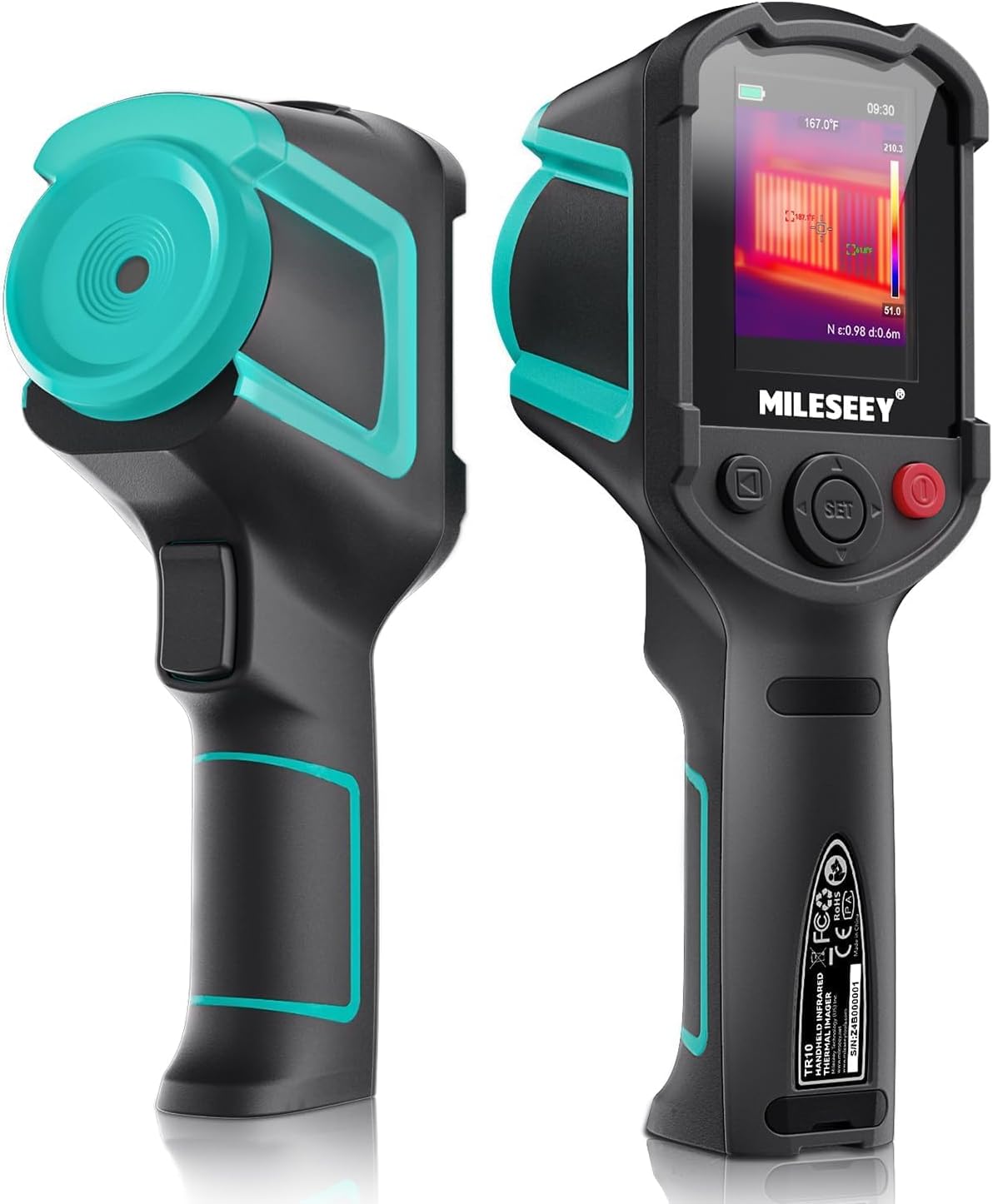
MILESEEY TR10 Handheld Thermal Imaging Camera, 192×192, 25Hz
Available to order
Included with qualifying purchases of $100 or more. Coverage begins on delivery and protects against manufacturing defects and failures under normal use.
- 30-Day ReturnsHassle Free
- 2-Year WarrantyOn qualifying $100+ purchases
30-day returns and damage protection Return most items within 30 days. If your order arrives damaged, we will replace it or refund you. Free shipping on every order.
Product details
The MILESEEY TR10 is an entry-level handheld thermal camera that works without a phone. A 192×192 infrared sensor, a 2.8-inch screen, automatic hot and cold spot tracking and an 8-hour battery come in a body rated IP54 and tested for 1.5 m drops, which makes it a practical first thermal camera for home and maintenance work.
At a glance
- 192×192 infrared sensor at 25 Hz
- -20°C to 550°C with ±2°C accuracy
- 2.8-inch screen, 8 GB storage, up to 8 hours of battery
- Auto hot, cold and center-point readings
- IP54 body with 1.5 m drop resistance
Full specifications
- Infrared resolution: 192×192 (240×240 display resolution)
- Thermal sensitivity (NETD): under 50 mK
- Refresh rate: 25 Hz
- Temperature range: -20°C to 550°C (-4°F to 1,022°F)
- Accuracy: ±2°C
- Field of view: 50° × 50°
- Display: 2.8-inch LCD
- Storage: 8 GB built in
- Battery life: up to 8 hours
- Durability: IP54, 1.5 m drop resistance
- Features: adjustable emissivity, auto maximum, minimum and center-point readings
What the specs mean in practice
Resolution. The 192×192 sensor gives 36,864 thermal pixels, a clear step up from 120×90 cameras. With a 50° × 50° field of view each pixel covers about 4.5 mm at 1 m (45 mm at 10 m), which is plenty for finding hot panels, pipes and wall sections.
Wide field of view. 50° lets you cover a whole electrical panel or wall section in one frame from arm's length.
Emissivity control. Adjustable emissivity lets you correct readings on materials that are not the default, such as painted or matte metal.
What you can use it for
- Floor heating and plumbing: trace loops and find cold zones or leaks.
- Insulation and drafts: scan walls, windows and ceilings.
- HVAC: check registers, ducts and equipment.
- Electrical: scan panels and outlets for hot connections.
Who should look elsewhere
- You need fine detail on small components. A 256×192 or higher camera such as the UNI-T UTi260B resolves more.
- You want a visible-light overlay on the image.
How it compares
- MILESEEY TR20: 320×240, 50 Hz and 40 mK or better sensitivity.
- HABOTEST HT821A: a 96×96 native sensor with 240×240 enhanced output.
Tips for better results
- Scan electrical equipment under normal load and compare like with like.
- Shiny bare metal reads cooler than it really is. Measure a patch of black electrical tape instead.
- Glass blocks thermal imaging, so you see the glass surface and not what is behind it.
- For building checks, a difference of roughly 10°C (18°F) or more between inside and outside gives the clearest results.
Frequently asked questions
Can I adjust emissivity?
Yes. Adjustable emissivity helps you get more accurate readings on shiny or unusual materials.
Does it work without a phone?
Yes. It has its own screen, battery and 8 GB of storage.
Is the temperature range enough for electrical work?
Yes for most panels, breakers, motors and HVAC components. The range runs to 550°C.
How rugged is it?
The body is rated IP54 against dust and splashes and is tested for drops from 1.5 m.
Is 192×192 good enough?
For finding hot and cold areas on panels, pipes and walls, yes. For small components, choose a higher-resolution model.
Common applications
Home maintenance, Insulation checks, HVAC troubleshooting. Choose a thermal camera based on the target size, working distance and required measurement accuracy.
Buying guidance
Compare native infrared sensor resolution, temperature measurement range and device compatibility before ordering. Image enhancement does not increase native sensor resolution. For questions about suitability, contact ThermalVisionPlus before purchase.
Thermal camera buying guides
Compare models and learn what specifications matter in our home inspection thermal camera guide, HVAC thermal camera guide, and phone versus handheld comparison.