
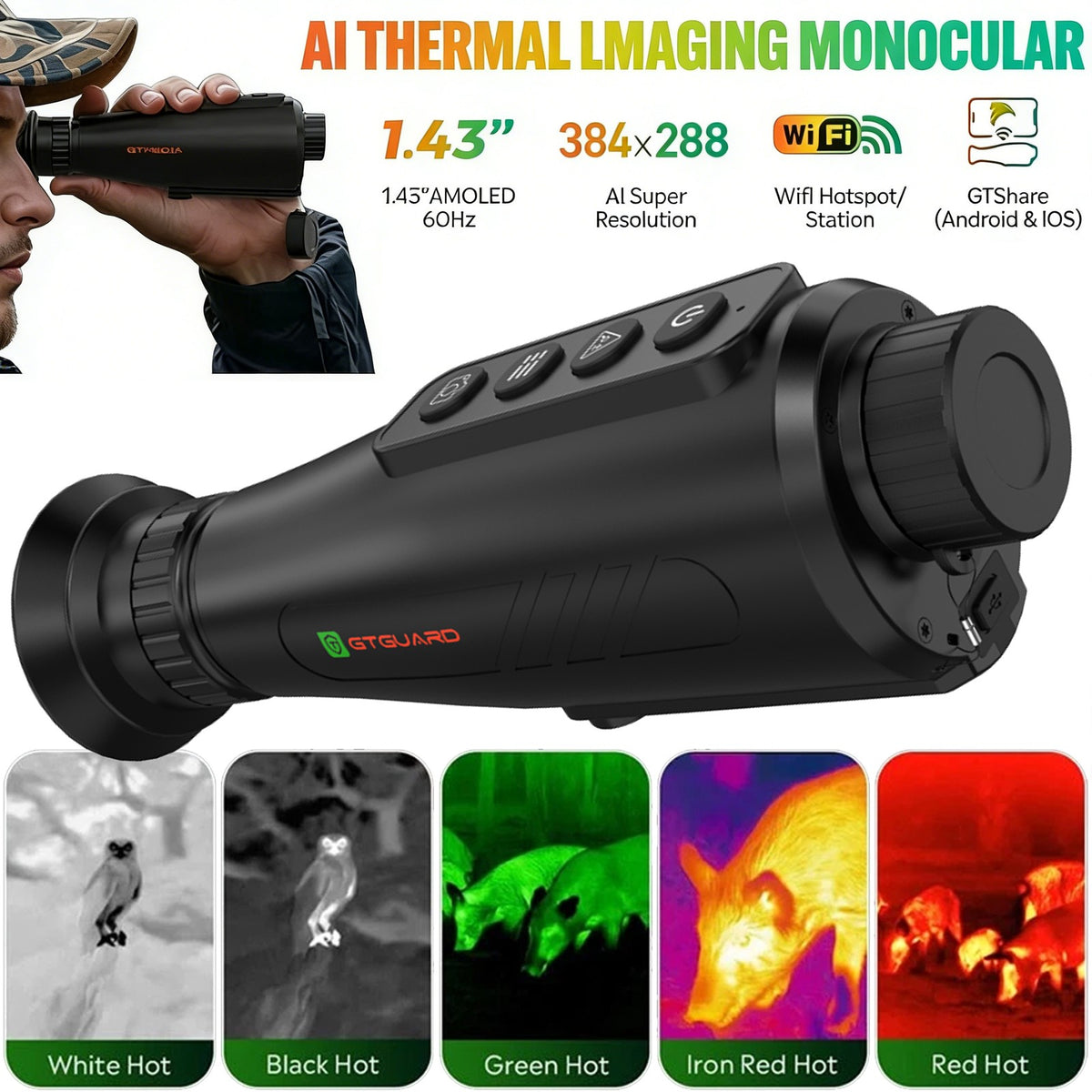
GTGUARD Hawkeye AI15 Thermal Imaging Monocular, 256×192, 50Hz, 15mm Lens
Available to order
Included with qualifying purchases of $100 or more. Coverage begins on delivery and protects against manufacturing defects and failures under normal use.
- 30-Day ReturnsHassle Free
- 2-Year WarrantyOn qualifying $100+ purchases
30-day returns and damage protection Return most items within 30 days. If your order arrives damaged, we will replace it or refund you. Free shipping on every order.
Product details
The GTGUARD Hawkeye AI15 is a handheld thermal monocular with a 256×192 sensor and AI super-resolution that displays like a 384×288 image. It adds a 50 Hz refresh rate, a 15 mm lens, an 8× zoom range and a sharp 1.43-inch AMOLED display, for fast, smooth tracking in the dark.
At a glance
- 256×192 sensor with AI super-resolution to a 384×288-equivalent image
- 50 Hz refresh rate and ≤40 mK sensitivity
- 15 mm lens and up to 8× zoom
- 1.43-inch AMOLED display and Wi-Fi hotspot
- About 12 hours of battery, 6 scene modes
Full specifications
- Sensor: 256×192, 12 μm
- Displayed image: AI super-resolution, equivalent to 384×288
- Thermal sensitivity (NETD): ≤40 mK
- Refresh rate: 50 Hz
- Lens: 15 mm
- Zoom: up to 8×
- Display: 1.43-inch AMOLED
- Detection range: up to about 1,500 m (manufacturer-stated)
- Battery life: about 12 hours
- Connectivity: Wi-Fi hotspot, with photo and video recording
- Modes: 6 scene modes, including normal, bird watching, rainforest and outline
What the specs mean in practice
Refresh rate. 50 Hz means the picture updates twice as often as a 25 Hz unit. Panning across a field or following a moving animal looks smooth rather than choppy.
Lens and spot size. A 15 mm lens with 12 μm pixels gives about 0.8 mrad per pixel, so one pixel covers roughly 8 cm at 100 m. That is what gives the AI15 its reach compared with wide-angle thermal cameras.
Detection versus identification. The roughly 1,500 m figure is the maximum distance at which a heat source can be detected. Recognizing and identifying a target needs a shorter distance.
What you can use it for
- Wildlife observation: track animals at night and in low light.
- Livestock checks: find animals in pastures after dark.
- Property monitoring: scan grounds, fences and outbuildings.
- Sharing footage: stream or copy images to a phone over the Wi-Fi hotspot.
Who should look elsewhere
- You want to measure surface temperatures for inspections. See our handheld cameras.
- You want a lower-cost entry monocular. See the CVLIFE BearMight.
How it compares
- GTGUARD H3: 12-hour battery, 32 GB and an IP66 body, with a smaller AMOLED viewfinder.
- GTGUARD X350: a 384×288 detector and a 35 mm lens for longer reach.
Tips for better results
- Scan slowly and in sections. Dusk and pre-dawn give the best thermal contrast.
- Glass blocks thermal imaging, so you cannot view through a windshield or window.
- Fog and heavy rain shorten effective range.
- Never point it at the sun or another intense heat source, and clean the lens with a soft lens cloth.
Frequently asked questions
Why does 50 Hz matter?
A higher refresh rate means smoother motion and less lag when you pan or follow a moving animal.
Is the picture real 384×288?
The sensor is 256×192. AI processing enhances the displayed image to look like 384×288.
Can I identify things at 1,500 m?
No. That is the maximum detection distance. Identifying a target needs a shorter distance.
Can I record video?
Yes. It records photos and video and offers a Wi-Fi hotspot for connecting a phone.
How long does the battery last?
About 12 hours.