
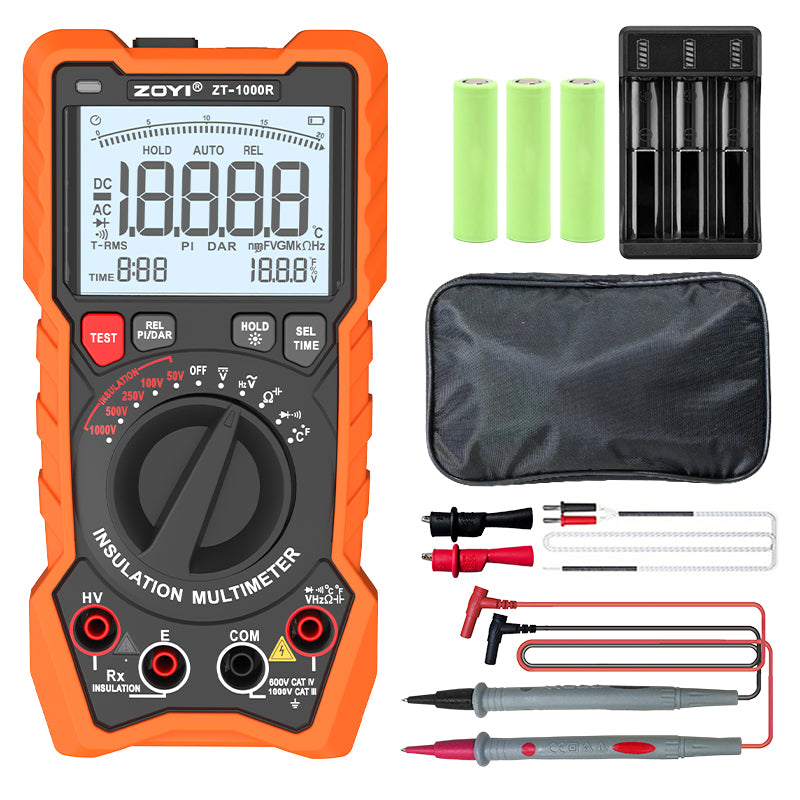
ZOYI ZT-1000R Insulation Tester and True RMS Multimeter, 1000V, 20GΩ
Available to order
Included with qualifying purchases of $100 or more. Coverage begins on delivery and protects against manufacturing defects and failures under normal use.
- 30-Day ReturnsHassle Free
- 2-Year WarrantyOn qualifying $100+ purchases
30-day returns and damage protection Return most items within 30 days. If your order arrives damaged, we will replace it or refund you. Free shipping on every order.
Product details
The ZOYI ZT-1000R combines a 1,000 V insulation resistance tester (megohmmeter) with a full 19,999-count True-RMS digital multimeter in one handheld unit. It offers five test voltages, reads insulation up to 20 GΩ and includes DAR and PI tests for motors, cables and installations.
At a glance
- Insulation tester with 50, 100, 250, 500 and 1,000 V test voltages
- Reads insulation resistance up to 20 GΩ
- DAR and PI analysis
- 19,999-count True-RMS multimeter with auto-ranging
- Backlight, data hold and flashlight
Full specifications
- Insulation test voltages: 50 V, 100 V, 250 V, 500 V and 1,000 V
- Insulation range: up to 20 GΩ
- Insulation analysis: DAR and PI (dielectric absorption ratio and polarization index)
- Multimeter: 19,999 counts, True RMS, auto-ranging
- Also measures: voltage, resistance, capacitance, frequency, temperature, diode, continuity
- Display: LCD with backlight, data hold and flashlight
What the specs mean in practice
Insulation testing. The tester applies a DC test voltage and measures how much leaks through the insulation. High readings in the gigaohm range indicate healthy insulation. Low readings can point to moisture, damage or aging.
Five test voltages. You choose a voltage to suit the equipment under test. A common choice is 500 V for circuits rated up to 500 V, with lower settings for low-voltage and sensitive equipment.
DAR and PI. These compare insulation readings taken over time. They help judge whether insulation is dry and healthy, and they are commonly used on motors and cables.
19,999 counts. The multimeter side resolves readings in finer steps than a 4,000-count meter, and True RMS gives accurate readings on non-sinusoidal waveforms.
What you can use it for
- Motors and pumps: check winding insulation before commissioning or after downtime.
- Wiring and cables: test installations for insulation breakdown.
- Appliances and tools: check for leakage to the casing.
- Everyday electrical work: use the multimeter side for voltage, resistance and continuity.
Who should look elsewhere
- You only need basic voltage checks. A simpler multimeter or the ANENG PN107 clamp meter costs less.
- You need a thermal camera. This is an electrical tester, not an imaging tool.
How it compares
- ANENG PN107: a clamp meter for measuring current without breaking the circuit.
Tips for safe, accurate use
- De-energize and discharge the circuit before any insulation test, and disconnect sensitive electronics first.
- Match the test voltage to the equipment's rated voltage.
- Keep leads and the surface of the insulation clean and dry for repeatable readings.
- Follow the safety instructions in the manual, and never exceed the meter's rating.
Frequently asked questions
What is an insulation resistance test?
The tester applies a high DC voltage and measures how much leaks through the insulation. Low resistance can mean moisture, damage or aging.
What are DAR and PI?
They compare insulation readings taken over time. They help judge whether insulation is healthy, and they are commonly used on motors and cables.
Is it safe to test live circuits?
No. De-energize and discharge the circuit before any insulation test.
Does it work as a normal multimeter?
Yes. It measures voltage, resistance, capacitance, frequency, temperature, diode and continuity.
Can I use it with a thermal camera?
Yes. A thermal camera finds the hot spot, and the tester helps you work out why.
Typical applications
Motor insulation testing, cable inspection and electrical maintenance. Compare the listed measurement capabilities, operating range and compatibility against your job requirements before purchasing.
Choosing the right instrument
Review the technical specifications above and contact ThermalVisionPlus if you need help choosing between models. For thermal cameras, distinguish native sensor resolution from software-enhanced image output.
Related thermal imaging guides
Explore our home inspection thermal camera guide, electrical inspection guide, and thermal camera buying comparison.